How Taylor Swift Built a Community Experience With the Eras Tour
“What if I told you none of it was accidental?”
Taylor Swift kicked of her sensational Eras Tour in the spring of 2023. Though we didn’t know it then, the tour would become the highest-grossing tour of all time, complete with its own film version and coffee table book. The success of the “Eras” concept is no accident. Carefully crafted by Swift, it taps into a universal sense of shared community and girlhood.
In May of 2023, I got into a car with my friend Sarah, her younger sister and her two friends, and headed from Montreal to Boston, all set for the show that would take place at Gillette Stadium in Foxborough, Massachusetts. Sarah’s teenage sister and her friends were crammed in the backseat. We referred to them as “the kids” throughout the trip. On the six hour drive up, I had a first-hand introduction to Gen Z slang. They tended to use the word “slay” unironically. “Is that a slay?”, showing a picture of an outfit on a phone screen. They constantly took pictures and videos of everything to post on Instagram and TikTok. Soon I had three new followers. As we navigated the streets of downtown Boston, they asked us to turn up the music. “Quiet down, we’re trying to figure out where to go!” I felt like a parent on a family road trip.
Arriving in Boston on Thursday afternoon, we explored the downtown Quincey market. We walked aimlessly among the red brick buildings in the harbour area. I ate a lobster roll. All the excitement of the weekend was ahead of us.
The kids were going to the show on Friday night. Sarah and I had tickets for Sunday. Taylor Swift was taking over Boston the whole weekend. We saw the effects the next morning at the hotel breakfast buffet.
“Look, those must be Swifties,” we whispered to each other.
One girl in the group had an on instantly recognizable beige knit sweater. “She’s wearing the Folklore cardigan.”
In the hotel room, we turned on the TV while the kids were getting ready for the show. The local news was reporting on the Taylor Swift phenomenon.
“As the Eras Tour arrives in Boston this weekend, you might see fans dressed up as different Taylor Swift ‘Eras’,” one of the anchors explained.
“So what exactly is an Era?” the other anchor asked.
“An Era refers to a phase of Taylor Swift’s musical career, which spans over 10 years now. Each one is associated to one of her albums. So, for example, her self-titled debut is characterized by curly blond hair, butterflies and cowboy boots. For her second album, Fearless, you might see lots of gold sparkles and the number 13 drawn on hands. The Speak Now Era is purple with ballgown style dresses, for Red you might see sunglasses and white t-shirts, for 1989 polaroid pictures and crop tops. Reputation is a darker Era, with a lot of black and snakes. Lover is pink hearts, Folklore and Evermore are more woodsy and magical, and finally, her latest album Midnights is stars and jewels and deep blue.”
“Wow, she really knows her stuff!” one of us said.
The concept of “Era” to define an album cycle was perhaps not invented by Swift, but it’s something she does so well it has come to be synonymous with her. Even before the marketing of the Eras Tour, people referred to periods in her life in that particular way: “She was really going through it during the Reputation Era.” Or: “I love the style of the Red Era.” Even unrelated to her albums, one could talk about Swift’s perhaps better forgotten “Kennedy Era” (that time she dated Conner Kennedy and dressed in red, white, and blue). Everything from her social media posts to her carefully curated public outings tie into the particular aesthetic world of the given Era.
Over the course of Swift’s first four albums, her style certainly evolved from the iconic country-inspired look of her early career. But the idea of a concentrated aesthetic embodying everything about her public image and tied to an album release cycle, only really started with her fifth studio album, 1989. Taylor Swift was famously disappointed that her previous album Red lost Album of the Year at the Grammys to Daft Punk’s Random Access Memories. She briefly thought she had won, noting that when announcing the winner, “they really dragged out the Rrrrr”. She had previously won Album of the Year for her sophomore project, Fearless, and wanted to prove it wasn’t a case of budding success that would fade over time. Though wildly popular, critics faulted Red for not having a cohesive sound, with tracks alternating from her more traditional paired-down country sound (“All Too Well”, “Begin Again”) to more bona fide pop songs like “22” and “We Are Never Ever Getting Back Together”. Taylor would fix that for 1989. In her 2023 re-release of the album, she wrote in the dust jacket “prologue” (another tool for defining the atmosphere of an era):
When I was 24 I sat in a backstage dressing room in London, buzzing with anticipation. […] Scissors emerged and I watched in the mirror as my locks of long curly hair fell in piles on the floor. […] I had a secret. For me, it was more than a change of hairstyle. When I was 24, I decided to completely reinvent mysеlf. How does a person reinvеnt herself, you ask? In any way I could think of. Musically, geographically, aesthetically, behaviorally, motivationally… And I did so joyfully.
Swift is intentional with the stylistic, aesthetic, and musical choices that define an Era and make it instantly and effortlessly recognizable — and calculated planning goes into an Era’s creation. 1989, a solidly pop album with a cohesive sound, went on to win Album of the Year in 2016, further cementing Swift as a pop superstar.
I first heard 1989 when it came out in 2014. It was my first year at university. I remember running on the treadmill at the YMCA, staring out the window at the busy downtown streets, and listening to a podcast dissecting an interview Taylor had given. “I’m not naturally edgy, sexy or cool”. The podcast host was skeptical, who is more sexy or cool than Taylor Swift? At the time, I had to agree, thinking about the publicity she got for leaving her New York gym dressed in heels, and questioning if she was putting on being disingenuous. Now I wondered if what she meant was that though her success was something that seemed like it came easy, it was not natural at all, it was carefully practiced.
Back in Foxborough, we got to the stadium early so we could wait in line to get T-shirts. A parade of concert-goers passed us, and as the news anchor had predicted, they were all wearing different outfits. The Eras were well-represented: I saw a girl covered in strands of ivy, a “Miss Americana” and matching “Heartbreak Prince”, boyfriends wearing t-shirts that said “Karma”, pajamas like in the “You Belong With Me” music video. Watching the carnival of Taylor Swift fans made the long line pass quickly, and soon, grasping our coveted T-shirts, we split ways with “the kids”, and headed back to the parking lot against the wave of people walking toward the stadium entrance.

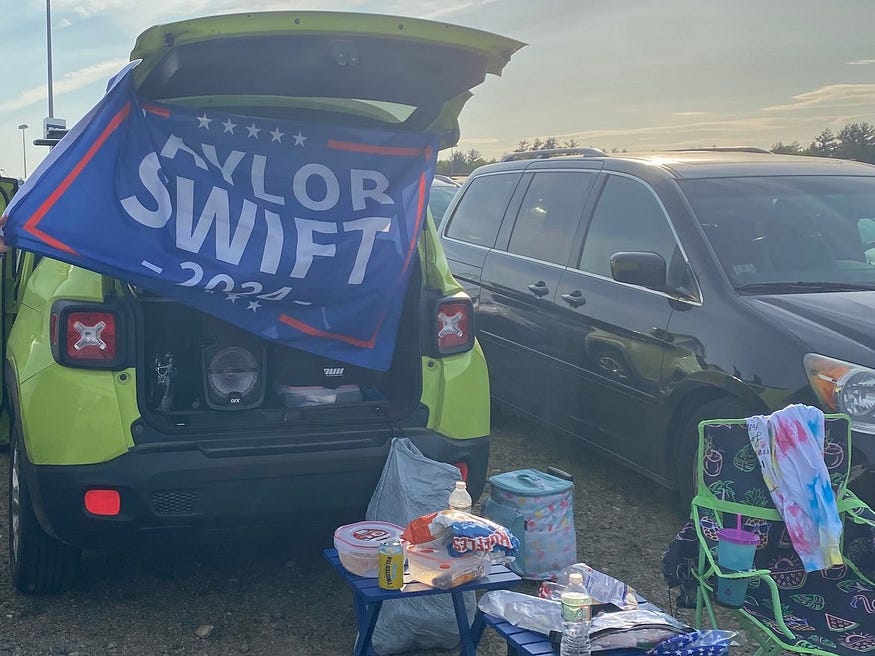
Sarah and I waited for the show to start at the car. People were tail-gating. I saw a big pink “Taylor Swift 2024” flag flying above a white Jeep. A group of women in an SUV across from us were playing corn hole. We joined them and exchanged bracelets. One woman was wearing a magenta fur coat and had her hair done like Taylor Swift in the “You Need to Calm Down” music video.
A defining phenomenon of the Eras Tour was something called friendship bracelets. The concept spawned from a lyric in the song “You’re On Your Own Kid”, off her then most recent album Midnights: “So make the friendship bracelets, take the moment and taste it…” On TikTok, videos of concert attendees making and exchanging home-made beaded bracelets with song titles, album names, and lyrics spread rapidly as the tour went on.
We had all met up a few days before the concert to make bracelets together and we were eager to trade them. The fun of it was to get creative. They contained little inside jokes and the fans we traded with understood them right away. Sarah made one that said “She’s fine”, referring to a viral TikTok video where Swift yelled at a security officer in the middle of performing her song “Bad Blood” on an earlier stop of the tour. I had “Starbucks lovers”, a misinterpreted lyric from the song “Blank Space”. I traded it for “Je suis calme” which Taylor yells in the “Me!” music video, set in Paris, when she pretends to get in an argument in French with Brendan Urie who features on the song. The girl who gave it to me was excited that I understood it and picked it out.
Shortly before the show started, we headed back to the stadium to one of the restaurants at Patriot’s Place. As we waited for our food, we sat amongst fathers waiting out the concert hidden away safely on comfortable chairs watching baseball. The red sox were at home.
Then, we got out our camping chairs and listened to the concert from outside the stadium, where we could hear surprisingly well. There were other fans, presumably ones who hadn’t been lucky enough to get tickets, doing the same, singing along as if they were attending. We weren’t there long before a middle-aged man approached us and struck up a conversation. He asked us if we were fans and we said yes. “You know she doesn’t even really play guitar?” Our friendliness froze over as he went on about how he didn’t understand how Taylor Swift could be so popular when she couldn’t really play instruments, until he finally left us alone.
The 1989 Era wasn’t the first time Swift over-corrected for criticism she had received, deserved or otherwise. The man outside of Gillette stadium made me think about an interview I’d seen of Taylor Swift around the time she first became famous. The interviewer said he had heard she could play a six-string guitar. She explained that one of her first guitar teachers told her it would be impossible to learn the less common instrument, because her hands were too small. Surrounded by her blond curls, she defiantly told the interviewer that she practiced until her fingers bled, just so she could prove him wrong. Over 10 years later, people were still doubting her, but it seemed to matter less now. We listened to the rest of the show in peace.
As the Foxborough concert entered the “Speak Now” era, and the fans around us sang along to Enchanted: “please don’t be in love with someone else”, I thought about how Taylor’s desire to prove critics wrong also influenced Speak Now, her third album. In response to accusations that her previous songs as being ghost-written — though she was cited as a writer on every track, she often worked with collaborator — Speak Now was entirely self-written.
The instinct to double down on her own ability would prove useful later in her career too. Thanks to having writing credits on every one of her songs, either solely or with collaborators, she was able to re-record her first six albums when the rights to the master recordings were sold to Scooter Braun in 2019. After having tried to purchase the masters herself, Swift’s original label sold them to Braun who she described as an “incessant, manipulative bully”. Though she wouldn’t be able to own the master recordings, she vowed to re-record the songs. This was possible since she retained the copyright of the lyrics and arrangements. A first in music history, it opened a larger discussion on predatory contracts between artists and record labels.
The re-recordings, which some analysts thought would never gain traction on streaming platforms over the originals, went on to inspire a renewed interest in Swift’s back-catalogue. This in turn led to the introduction of newer fans to her past work, which culminated in the Era’s tour, a “trip in time through her musical past,” thanks in no small part to her marketing strategy around Eras.
On Saturday, we explored the Harvard area. At a used book store, the cashier commented on the matching crew neck sweaters we had bought at the concert. It felt like all of Boston knew Taylor Swift was in town.
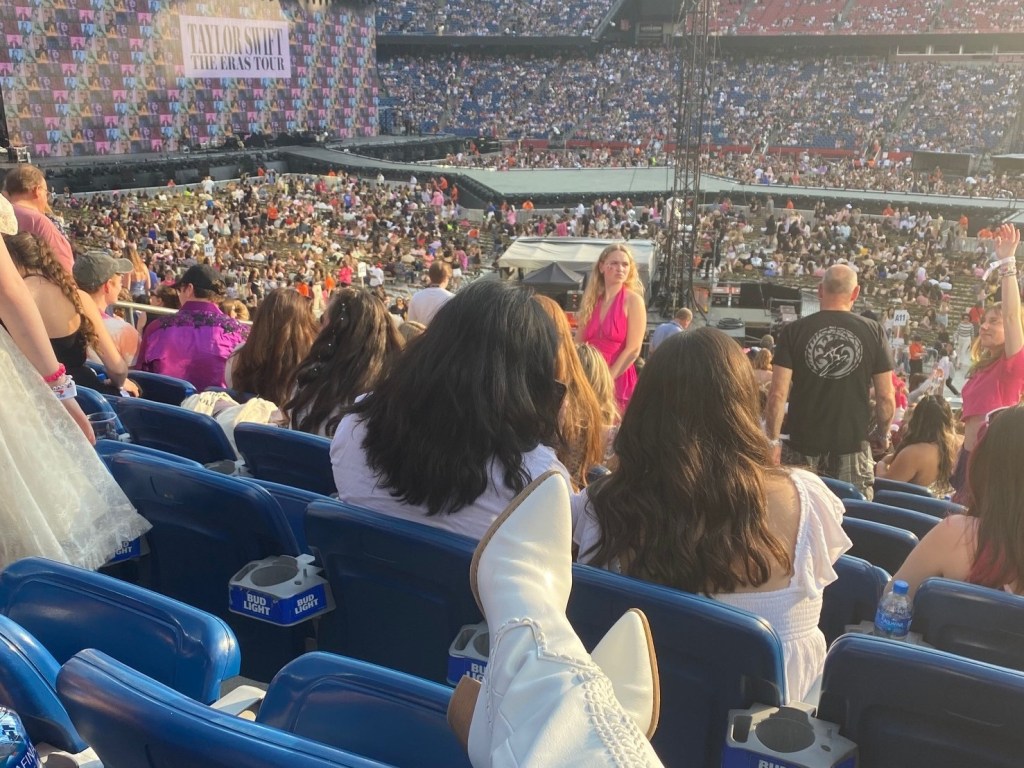
Then on Sunday morning, Sarah and I got ready for our turn to see the show, this time from inside the stadium. I curled my hair and one of the girls drew a 13 on my hand. The final touch was my white cowboy boots, that I’d bought in Texas. Sarah dressed as Reputation in a mesh black top and black jean jacket with rhinestones on them. This time, I drove the 30 miles to Foxborough. Merging onto the highway, a pick-up truck cut us off. “I hate that stupid old pick-up truck you never let me drive!” I shouted.

As we got closer to the stadium, the Taylor Swift traffic thickened. We could see groups of girls in twos and threes singing along to music in the other cars. A van had the words “Eras Tour or Bust” painted onto it. Another said: “We are in the Getaway car going to the Eras Tour!” We were listening to music loud and singing along. One girl rolled down her window and tossed a little gift bad with bracelets in it to me. Though the traffic slowed us down almost to a standstill, the collective anticipation was thrilling.
In the parking lot, everyone was tailgating, with BBQs, more flags, and music. We sat in camping chairs in front of our car as we waited for the show to start, soaking in the sun and listening to music from the cars next to us. We traded more bracelets with girls wearing sequins and pink cowboy hats. We met a girl and her boyfriend, who was wearing a shirt that said “Karma”, referencing the lyric “Karma is my boyfriend.” I said it was fun to see what everyone was wearing, and how people made their boyfriends dress. Though I didn’t intend any, I think she took offense, saying “I didn’t make him wear that, he wanted to!”
Eras are also about who your boyfriend is. But not in a way that puts a man at the center of your life, more like as an accessory. What purse is Taylor carrying today, and which guy is on her arm? Now that she is solidly in her Football Era — when I saw the show for a second time in Toronto in 2024, many boyfriends were dressed in Chiefs jerseys — it’s easy to forget where she was when the tour started. Her breakup with Joe Alwin (artsy, handsome film actor type) had been announced just weeks into the tour. Retroactively, we tried to find hints to the reason for their breakup in her latest album. The mythology of Taylor’s relationships, the details of which slip through in her evocative song lyrics, are part of the irresistible allure of the Taylor Swift universe.
Swift has always been know for writing about her boyfriends. Something she chafed against in the 1989 Era (portraying herself ironically as a crazy ex in the “Blank Space” music video), she now seemingly embraces, baring her diaristic “tortured poetry” on her latest record. Much of the poetry in The Tortured Poets Department is thought to be about Matty Healy, edgy bad-boy front man of The 1975. Glimpsed at her Nashville show a couple weeks before we attended in Foxborough, he is “gazing at me starry eyed” on her bitter track “The Smallest Man who Ever Lived.” By the time Swift kicked off the European leg of her tour in Paris in May 2024, the TTPD Era had been added to tour’s setlist. Before the Era’s Tour had wrapped up, Matty Healy went from attending as her special guest to song lyric being dramatically performed on stage. An Era playing out in real time.
Walking around the parking lot of Gillette Stadium back in May 2023, you could hear a Taylor Swift song playing from one car, and as you passed, it would fade while another one from the next car got louder. They were all different, and there were so many good ones. Everyone being united in appreciation of Taylor Swift felt powerful. Her public image, her controversies, and her relationships didn’t really matter. Everyone was united in loving the music and participating in the trends and laughing at the inside jokes. It was almost like it wasn’t even really about Taylor Swift herself at all. It was like a sports team: the players, the managers might come and go, we criticize and even hate some of them, but we all love the team colours. It was a reason to get together and make connections. We could argue among ourselves that the T-shirts were too expensive, that her latest album was a cash grab, that she polluted too much with her private jet, or that she was rude to Celine Dion at the Grammys, but it wasn’t really about her. It was about Taylor Swift as a concept. We knew she wasn’t perfect, but we were devoted to the brand, the camp.
The show was as good as we hoped it would be, but what I’ll remember most about the Eras Tour is the moments leading up to it and the feeling of community tailgating at Gillette Stadium.
Driving back to Montreal on Monday, we listened to Midnights on the Target exclusive CD we had bought while we were in the States. It was the only way to listen to the song “Hits Different” (it would end up being released a few days later on streaming after the New York Eras Tour show, and we joked that we fell for the marketing ploy again), and we listened to it on repeat. As I drove across the Champlain Bridge onto the Island of Montreal, I said “one more time!” and restarted the track. We all sang along as we crossed the bridge and came back home.
 selective
Leave a comment