
My 7 step process for achieving personal goals
January marks the beginning of a new year and with it comes the desire to set New Year’s resolutions. For many people, the idea of setting objectives for the upcoming year brings with it a sense of dread. Resolutions like “Exercise more” or “Quit drinking” are quickly abandoned, and by now, the end of January, we often slip back into old habits.
Being born at the beginning of the year makes me a Capricorn, said to be organized, ambitious, and practical. If the astrologists are to be believed, it also means I’m particularly energetically aligned with the period that stretches from the end of December to the beginning of January, when we celebrate the end of year, relax and reset, then start to look forward and plan what’s to come.
As a skeptic, I must admit I know many Capricorns who I wouldn’t exactly call organized, and like many others, struggle with sticking to their resolutions and goals. Over the last few years, I developed a strategy for setting and (more or less) achieving my personal goals, which I have tried to share with some of these friends and family members.
“I’ll tell you the secret to my success,” I said to one of my friends jokingly last year. I asked him to write down a few goals for each quarter of the year. What did he want to get done? It was simple, written on a post-it note and pasted above his work desk. He was skeptical at first, but by the time 2024 came to a close, he had achieved 5 out of 7 of the items on the list. Some people might liken this to “manifesting”, the pop psychology idea that by just imagining what you want to happen and focusing on it, you can make it happen. Personally, I would agree it is helpful to have a positive mindset, but there is a little more to it than just closing your eyes and wishing — or at least so says my Capricorn practicality. In any case, this January, my friend paid a bit closer attention when I explained my process in more detail. It inspired me to share it here.
Step 1: Values & Retrospective
The first step of meaningful goal-setting is figuring out what is important to you and what you want to be spending your time on. I once took a seminar on productivity that referenced Stepehn Covey’s famous productivity best-seller The 7 Habits of Highly Effective People. This was the first time I heard about his idea of “beginning with the end in mind.”
Habit 2 of the self-help Bible begins with a thought experiment. You are attending your own funeral. It sounds morbid, but the idea is to imagine what four people — a family member, friend, co-worker, and community member — will say when they stand up to speak about you. Essentially, what do you want to be remembered for?
“What kind of husband, wife, father, or mother would you like their words to reflect? What kind of son or daughter or cousin? What kind of friend? What kind of working associate?
What character would you like them to have seen in you? What contributions, what achievements would you want them to remember? What difference would you like to have made in their lives?”
This thought experiment is meant to help you identify your values, so that you can ensure you are spending your time on the right things. For example, would you prefer your family to say “she got the dishes done every night,” or something more like: “she always had time for an meaningful conversation”? As cheesy as it sounds, when trying to identify meaningful goals for yourself or resolutions to improve your life, it’s essential to identify what a successful life well-lived looks like for you.
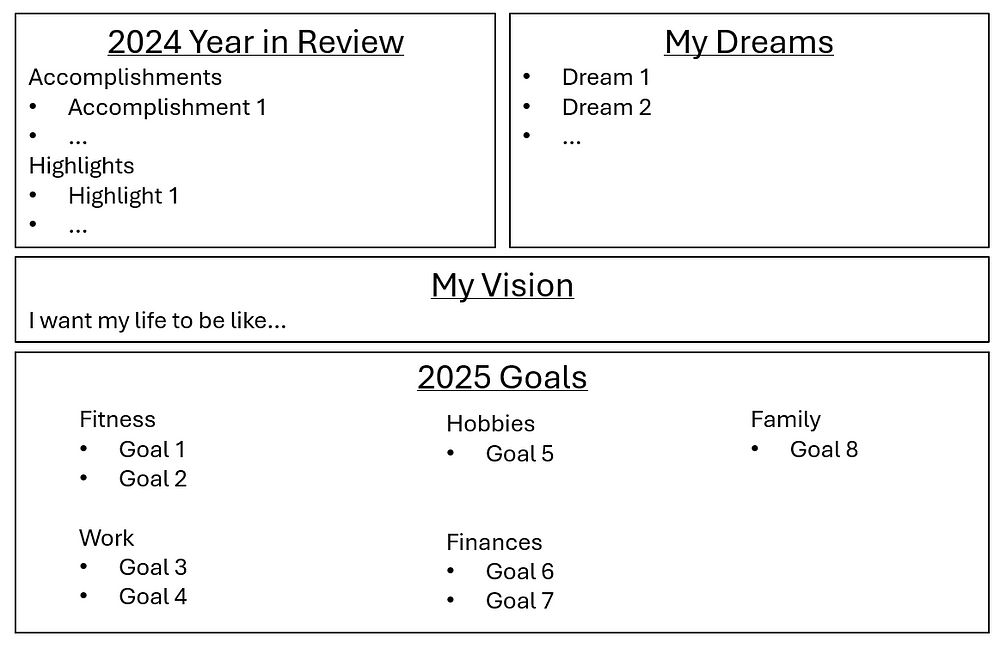
Once you have been setting goals consistently for a while and have a good idea of your overall values, your first step can be the previous year’s retrospective. Look back on the year and identify the highlights and your key accomplishments. See how many of your goals you accomplished. Use this as motivation and a starting point for the next year’s goals. It’s a good time to re-assess. Maybe some of your priorities have changed, and it’s time to focus on something new.
Step 2: Vision
Another useful way to figure out what you should prioritize for the year is to write down what I and goal-setting enthusiasts call your “Vision.” TikTok enthusiasts will be familiar with the Vision Board. This is the practice of cutting out pictures from magazines and creating a collage of your ideal life. Scenes of pristine beaches and apartments from Architectural Digest will most-likely adorn the creation which can be hung up above one’s bed, but you can just as easily create a written version of your Vision. Write out what your dream life would be like: where you would live, how you would spend your time, and who you’d spend it with. Let your imagination run wild, and by next year, see how close you end up. You might be surprised.

Step 3: Laundry List
The next step is to make a list. Write down all the things you’ve ever wanted to do. They can relate back to your vision: “take a trip to the seaside” or “buy my dream apartment”. It doesn’t have to consist of only things you want to do this year. Brainstorm possibilities.
The idea of this process is to start wide and narrow down as you go. From your values and your vision, you now start to identify specific items, which will lead you to your goals.
Step 4: Goals
Now you will identify the goals to focus on this year. After spending time in the clouds, it’s time to start getting more down to earth. Out of everything on your laundry list, what can you realistically accomplish this year? Be ambitious but try not to select too many different things. At this stage, it can also help to split your goals into categories. Choose 3 to 6 categories for different things in your life. Many planners with goal-setting templates will include a category breakdown. Examples can include Fitness, School or Work, Finances, Family, or Hobbies.
These will be the big milestones you use to measure your success or your progress at the beginning of next year. The key to goal-setting is being specific. It should be easy to identify if you’ve accomplished each item when you look back on your year. So, instead of writing down “Get in shape” or “Save money”, aim to “Run 10k without stopping” or “Put away 5000$ in your TFSA account”. The idea is that at any time you can go through your list and identify if each goal has been accomplished yet. If your goal isn’t specific enough — something like “Go to the gym more” — it will be difficult to tell if you are on track or even if you accomplished it at all. You probably have gone to the gym some times, but probably not every day. How much is “more” anyway?
Personally, I don’t consider habit-based goals like “Exercise twice a week” or “Read every day” very helpful for the same reason. They are specific, but over the course of a year, you will probably not have done it every week. Would you consider this a failure? The idea is to set yourself up for success and to keep your motivation high all year. Think of it like being in school. You may aim to study every day, but your ultimate goal is to pass the class. If you have a clear binary measurement of your success, even if you don’t hit the milestone by the end of the year, I can almost guarantee you will have made progress, and not have forgotten by March that you were supposed to go to the gym every week.
Step 5: Quarters
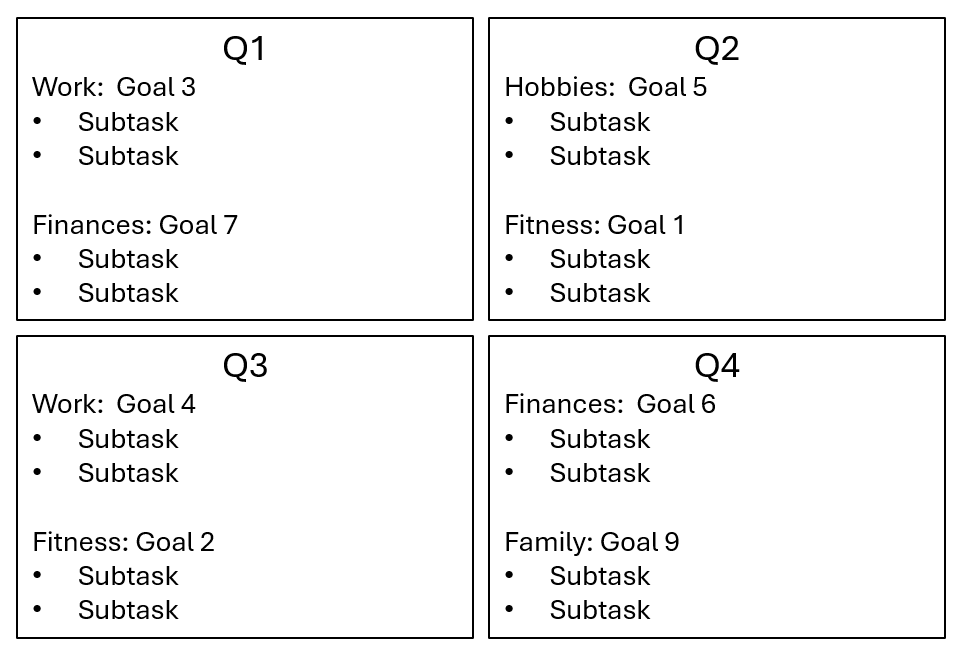
Now we break it down further. In business, the year is split into four quarters. This approach is also helpful in the business of goal-setting. A year seems like a long time, but it is really only four quarters, each made up of three months. It can be easy to get caught up in day-to-day tasks and feel like a month has gone by without even noticing it. That’s why breaking down a goal in chunks, and noting your progress throughout the year can be so helpful.
At this point, you should have a few categories with one or two big goals in each. Think about what steps you need to take to achieve the goals. For example, if your goal is to buy a car, you will probably need to do some research, choose what car you want, save some money, meet with dealers, and so on. Start with Q1 and pick one to three goals to focus on in the next three months, identifying subtasks needed to make progress. Another reason why using quarters is powerful, is it allows you to compartmentalize and focus. By choosing a few goals to focus on, you can essentially “forget about” the others, knowing they will be slated in a later quarter. If you have some time sensitive goals — a vacation you want to take in the summer or a race to run in the fall — note where they fall in the calendar and slate your preparation in the appropriate quarter.
Step 6: Months & Weeks
In Step 6, you get to go shopping. You will need a calendar. I like to use an agenda that’s divided into weeks, but you can use an online one on your phone just as easily. Besides jotting down appointments and meetings, every week, you can identify some tasks you need to do to push your goals forward. Usually, by aiming to do just a few things every week, you can get a lot done. Every month (remember you only have 3 to get those Q1 tasks done!) check in to see if you’re on track.

Step 7: Be flexible
This one is not really a step, but I wanted to have 7 points like Stephen Covey. It’s ok to change your priorities during the year or decide you don’t want to do something anymore. After all, man makes plans and God laughs. It’s also ok not to achieve everything: you’ll just have a starting point for one of your goals next year! The joy of goal setting is you get to do it over and over again every year.
This year, for my January birthday, I invited a few girl friends over for tea. I had asked them not to bring any gifts, so I got a few cards instead. Once they left I sat down to carefully read the cards. Just a few days before, I had been explaining Stephen Covey’s funeral thought experiment to my friend. Reading my the messages in the cards, I realized they were pretty closely aligned with what I thought about when I did my own thought exercise in that seminar a few years ago. I couldn’t have asked for a better birthday gift.

“If you fail to plan, you plan to fail” — Taylor Swift
 selective
Leave a comment