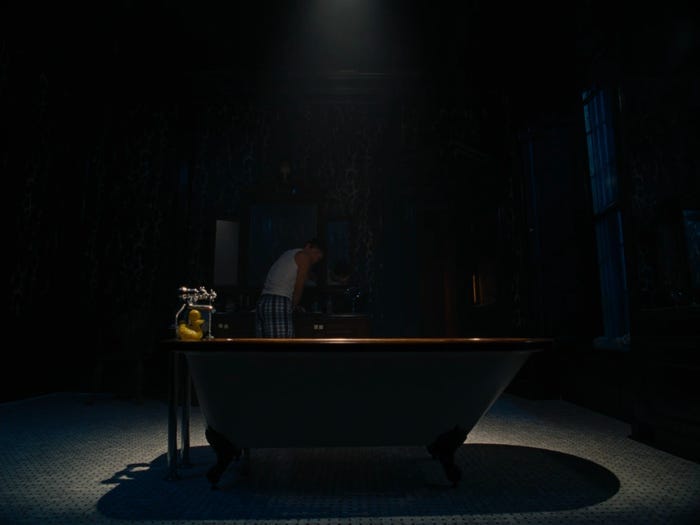
It was warm, luxurious, steamy, and it made me think about how baths can be a good metaphor for decadence. The steam that rises can obscure things and blur lines, much like the themes explored in Emerald Fennel’s Saltburn. A breakout film in late 2023, it quickly became iconic for its performances (Jacob Elordi, Barry Keoghan, Rosamund Pike), its cinematography (shot in a 4:3 aspect ratio), and its originality. When the highest grossing movies are often remakes and sequels, an original screenplay is a welcome change. But how original is the racy drama, set against the backdrop of Oxford and an English country estate? Reviews rightfully described the movie as a modern take on several classic stories from English literature like The Talented Mr. Ripley, and notably, Brideshead Revisited, the 1945 novel by Evelyn Waugh.
Saltburn is the story of Oliver (Barry Keoghan), a middle class Oxford initiate who befriends his eccentric, magnanimous, and rich classmate Felix Catton (Jacob Elordi). When Felix invites Oliver to spend the summer at Saltburn, his family home, Oliver is drawn into a world completely alien to his modest background and has to manage interactions with Felix’s family members, including his moody sister Venetia and his elegant but pretentious mother Elsbeth (Rosamund Pike). As Elsbeth, Pike delightfully portrays English upper-class manners. In her introductory scene, Oliver overhears her gossiping about his alcoholic mother. When he enters the room, Felix’s cousin Farleigh, another Oxford classmate, says that they were just talking about him, to which Elsbeth protests sincerely: “Of course we weren’t! You just make up the most awful things!” In an interview, Rosamund Pike described the inspiration for her portrayal of the character saying, “if you lived in England for any period of time you will know women like this”.
And it’s not the first time the English aristocracy is satirized in film or literature. The novel Brideshead Revisited was written by Evelyn Waugh during World War 2 while he recovered from a parachute accident. Similarly to Saltburn, it tells the story of a middle class Oxford student, named Charles, who is enthralled by Sebastian Flyte, an eccentric socialite who carries around a teddy bear called Aloysius. Like Oliver, Charles is invited to his friend’s family estate, Brideshead Castle, where they share adjoining rooms connected by a bathroom featuring an extravagant tub.
I was always given the room I had on my first visit; it was next to Sebastian’s, and we shared what had once been a dressing-room and had been changed to a bathroom twenty years back by the substitution for the bed of a deep, copper, mahogany-framed bath, that was filled by pulling a brass lever heavy as a piece of marine engineering; the rest of the room remained unchanged; a coal fire always burned there in the winter. I often think of that bathroom — the water colours dimmed by steam and the huge towel warming on the back of the chintz armchair — and contrast it with the uniform, clinical, little chambers, glittering with chromium-plate and looking-glass, which pass for luxury in the modern world.
In both the film and the novel, our hero quickly abandons the first friends he has made at school once he is drawn into the orbit of an alluring elite family. Both characters are drawn to the mystery and decadence of the opulent country estate and what goes on inside it.
After dropping out of Oxford to become an artist, Charles initially makes a name for himself in the art world by painting commemorative portraits of the country houses of aristocratic families forced to sell their ancestral seats in the modern times of the 20th century. In essence, Brideshead Revisited is an ode to these country seats. Brideshead Castle is almost revered in the final soliloquy spoken by Lord Marchmain, Sebastian’s father, which eludes to the depth of its history. “Aunt Julia knew the tombs, cross-legged knight and doubleted earl, marquis like a Roman senator, limestone, alabaster, and Italian marble.” And of the chapel he says: “I gave it to her. We’ve always been builders in our family. I built it for her; in the shade of the pavilion; rebuilt with the old stones behind the old walls; it was the last of the new house to come, the first to go”. The novel imagines these kinds of estates as wonders lost to modernity; it concludes with World War 2 soldiers overrunning Brideshead. However, the metaphorical light in the chapel is still burning. Even by 1956, Waugh wrote in the preface of his novel’s new edition that there had been a resurgence in what he called the “cult of the English country house”. He had had no need to worry about the enduring impact of stately homes when he wrote Brideshead Revisited in 1944. Almost 100 years later, as the popularity of a movie like Saltburn shows, our sordid fascination with the English country estate, and what goes on inside it, is alive and well.

And according to Saltburn, exactly what does go on can be quite salacious. The movie went viral for several of its shocking scenes. Particularly, an erotic moment in the ornate bath tub in the shared bathroom between Oliver and Felix’s rooms, where Oliver clandestinely watches his friend take a bath before entering himself after Felix leaves. The scene sparked discussion and reactions online, like a TikTok drink recipe dubbed “Jacob Elordi’s bath water cocktail”. The 2001 song “Murder on the Dance Floor” also went viral because of the closing scene where Oliver dances around his newly acquired property naked.
But although these kind of moments can make a movie memorable, the point of the bathtub scene in the overall story is unclear. Ostensibly it reveals Oliver’s obsessive devotion to Felix. The film’s writer-director Emerald Fennel has cited obsession as one of the driving themes of her story: “I drew from my own experience of being a human person, who has felt that thing we all feel at that time in our life which is that absolute insane grip of obsessive love…But obviously I didn’t quite go to the lengths that some of the people [in the film] do”. However, as the story progresses, it is revealed that Oliver has been acting out a calculated plot to take possession of the Catton’s home all along. In light of this, where does his “obsessive love” fit in? Is that obsession part of the reason Oliver infiltrates his friend’s home, so he can move in and, in a way, replace him? Seemingly not, since we are shown he has set the wheels of his scheme in motion before even getting to know Felix. Are we then to believe his obsessive love accidentally arose, throwing a wrench in Oliver’s otherwise coolly cunning plans? By the end of the film, one feels unsure of Oliver’s true motivations and his victory dance around the coveted Saltburn estate rings hollow.
Brideshead Revisited, on the other hand, is also famous for portraying a gay relationship between friends. It does so much more subtly, to the point that some critics argue that the characters’ relationship is actually platonic. However, Waugh’s intent seems clear, with several characters discussing Charles’ feelings for Sebastian in the novel. However, the overall significance of Charles’ romantic connection with Sebastian, and later with his sister Julia, is almost symbolic of his infatuation with old world beauty and traditions, the exploration of which is the main thrust of the novel. Though in modern times, these relationships can be portrayed much more explicitly in fiction, a lack of deeper meaning can leave them feeling flat.
Another important part of the allure of the country estates in both stories is their aesthetic value. At Brideshead, Charles, an artist, is initially drawn to the beauty that surrounds him. “It was an aesthetic education to live within those walls.” Charles’ relationship with Sebastian and his first impressions of his family’s estate are often linked with the classical notion of Arcadia, the idyllic image of an innocent paradise. The descriptions of Brideshead are extensive, so much so that Waugh expressed regret in his 1956 preface of the novel that he may have overdone it: “It was a bleak period of present privation and threatening disaster — the period of soya beans and Basic English — and in consequence the book is infused with a kind of gluttony, for food and wine, for the splendours of the recent past, and for rhetorical and ornamental language, which now with a full stomach I find distasteful.” However, Charles’ youthful innocence sours as the novel progresses, and the casual extravagance of the Flyte family is revealed. For example, at Christmastime, Julia’s fiancé buys her a tortoise with a diamond-encrusted shell spelling out her initials. Later the turtle disappears, and the family flippantly assumes it has buried itself. By the end of the novel, Charles comes to realize that the aesthetics he once idolized are ultimately shallow in comparison to life’s greater mysteries.
Saltburn is as visually atmospheric as Brideshead is descriptive, drawing the viewer in to the storied halls of Oxford and the decadent Saltburn mansion. Saltburn is filled with rare art, oak furniture and its grounds feature an elaborate hedge maze. But as the film progresses, one gets the sense that the Cattons don’t fully appreciate, and by extension don’t deserve, the exceptional and rare art pieces they have inherited. Oliver remarks on some 16th century ceramic plates by Bernard Palissy — which he later uses in a scheme to frame cousin Farleigh — that Felix is ignorant of. At Oxford, Oliver and Farleigh share an English literature seminar, and though Farleigh hasn’t read the book, he is praised for his personal connections. However, the sense that Oliver is more deserving of the Cattons wealth because he is more cognizant of the cultural significance of their possessions is muddled by his callous scheme that tonally seems to suggest the wealthy are inherently gullible and can be easily taken in by a conman. Even the theme of class revenge is not quite there since Oliver is revealed to come from a fairly well-off middle class family. Ultimately, Oliver is obsessed with the aesthetic and monetary value of Saltburn, and he rejoices when he finally gains possession of it at the end of the film.
In Brideshead, although Charles also comes close to inheriting the estate by marrying Julia, he comes to have a deeper appreciation of the spiritual, rather than aesthetic, value of the property by the end of the novel. The novel is framed by Charles rediscovering the estate while he is an officer with the army during the Second World War. At this stage in his life, he is “homeless, childless, middle-aged and loveless,” and finds the home he once loved desecrated by the soldiers, who are using the estate as a base. However, the chapel, the one part of Brideshead that Charles thought lacked architectural merit in his youth, has been re-opened for the soldiers’ use. There is a sense that this place will endure, in spite of a changing world. Though the deeply religious nature of the novel’s conclusion (Waugh would convert to Catholicism later in his life) would not necessarily make sense for a modern blockbuster, the lack of heart in Saltburn ultimately marks the difference between two outwardly similar stories.
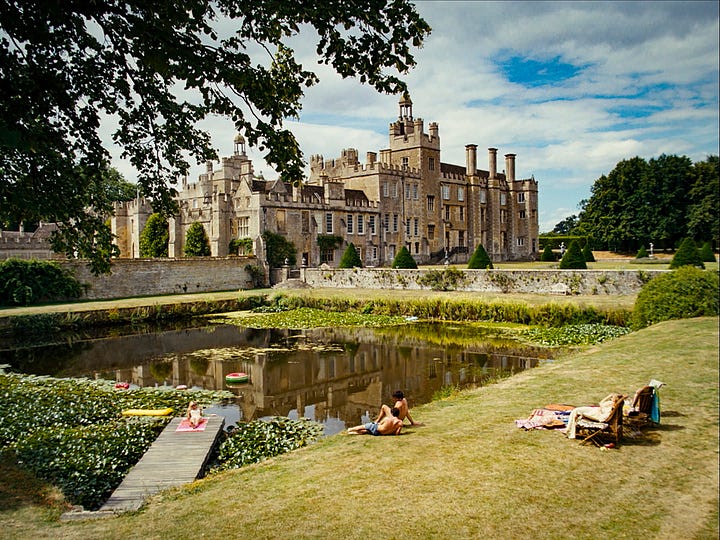
Saltburn’s writer-director Emerald Fennell is a socialite herself, more Julia or Venetia than a hanger-on like Oliver, Charles or even Evelyn Waugh. Perhaps it isn’t surprising then that her creation lacks the particular sensitivity of someone on the outside looking in. A resurfaced Tattler article describes her 18th birthday party, painting a picture that is remarkably like Oliver’s birthday celebration in Saltburn, complete with angel wings on the backs of suits and butterfly headdresses, and attended by socialites and aristocrats. One wonders if she sees herself as an outsider like Oliver or as an insider like Felix. Ostensibly, the movie is about destroying the upper class; it doesn’t show any sympathy for them. Fennell is perhaps rebelling against her upbringing or her peers. Brideshead Revisited, on the other hand, differs in that it is equally scathing as it is compassionate. In the end, it shows grace.
As one of Charles’ Oxford peers, Anthony Blanche, warns him at both the beginning and end of the novel, the Flyte family is charming. After going to a viewing of Charles’ latest pictures which depict the South American wilderness, he dismisses the exhibition: “It was charm again, my dear, simple, creamy English charm, playing tigers.” And in my opinion, so is Fennell’s film. The seemingly original movie is refreshing, but it is sorely lacking in substance. Saltburn is English charm. As Anthony portends, it will destroy us.
“I took you out to dinner to warn you of their charm. I warned you expressly and in great detail of the Flyte family. Charm is the great English blight. It does not exist outside these damp islands. It spots anything it touches. It kills love; it kills art; I greatly fear, my dear Charles, it has killed you.”
 selective
Leave a comment