
“The best way to train for a marathon is to sign up for another marathon and run it with no expectations.” This was the kind of advice I’d receive when chatting with people I met at my local running club, avid runners who’d run multiple marathons before. Advice about running marathons, and about running in general, is plentiful in the running community, both online and in real life. But one of the biggest lessons I learned from completing my first marathon is that while advice can sometimes be helpful, the most important person to listen to is yourself.
I started running when I was in college, at first simply to stay in shape. After a stressful day, doing a loop around the neighbourhood, or getting fresh air running up Mount Royal between classes, was a way to clear my head, listen to music, and not think about anything in particular, except maybe how much longer until this run is over? In 2017, I ran a half marathon with one of my best friends at the Rock & Roll Montreal Marathon. Though the race takes place in late September, a freak heat wave with temperatures exceeding 35 Celsius caused the marathon to be cancelled and the half to be moved up an hour earlier. Starting on the Jacques-Cartier bridge, running around the Circuit Gilles Villeneuve before heading into the city, we fought against the heat, being sprayed with hoses and dumping water on ourselves at the aid stations along the way, and when I reached the finish line at Parc Lafontaine, I remember thinking: there is no way I could run that distance twice.
While going on a jog on a clear fall day or running with friends before stopping for coffee is a nice and reasonable way to spend one’s time, why would anyone want to run 42.2 km? According to legend, during the Ancient Greek Battle of Marathon in 490 BC, Philippides saw a Persian vessel heading towards Athens and wanted to warn them, running the distance between the two cities, discarding his armor as he went. When the modern Olympics came to be in 1896, one of the signature events was the marathon, paying tribute to the Greek origin of the games. The distance from Marathon to Athens is approximately 40 km, depending on the route you take, and the first few Olympic marathon distances varied in length until the distance was standardized at 42.195 km in 1924. Since then, hundreds of marathon races are held each year across the world, where thousands of people challenge themselves to run this somewhat arbitrary distance. I’m still not sure exactly why I wanted to do it. After all, in the legend, Philippides collapses and dies after delivering his message to Athens. It’s not exactly a glowing endorsement of the modern marathon. But as running longer and longer distances became easier and easier, it seemed like it was the next thing to tackle, the next step on a ladder that started at 5 km and continued all the way to ultramarathons.
Whatever the reason, I had set my goal for 2024, and at the beginning of the year, signed up for the P’tit Train du Nord Marathon, which would take place in October in the Laurentians region, just north of Montreal. The course runs along a train track turned recreational path from the town of Val-David south to Saint-Jerome. The trail is a popular cycling path in the summer and cross-country ski trail in winter, winding north past scenic views all the way to Mont-Tremblant. The historical train stations serve as entry points for visitors and often offer stops for ice cream or a beer along your route. I had cycled and skied and even run on parts the path many times ever since I was child, usually with my dad and brother, and I always wanted to try the marathon there, which is advertised as the fastest in North America, due to its overall elevation loss of around 200m over the 42.2km. I excitedly texted my dad when I signed up. He wanted to do it too.
One of the first things I did after signing up was google: Can I run a marathon? I was plunged into a world of online training plans and fitness influencers that all had slightly different takes on marathon running. My plan was to continue running throughout the winter to keep up my fitness from the previous summer, and start training seriously in June. Running in the winter in Montreal isn’t easy. Freezing temperatures cause frost to build up on your face, snow sticks in your eyelashes sealing them shut, and treacherous ice covers streets and pathways. Luckily, I am not the only person crazy enough to want to run in these conditions, and joining a running club provided motivation (with the promise of post-run beers) to keep getting out there week after week, which got me through to the spring.
At the running club, it seemed like everyone had done multiple races or was planning to. People asked me if I was training for anything, and I sometimes felt hesitant to admit I had signed up for a marathon, since I would be flooded with follow-up questions.
“How long have you been running?”
“Have you done many half-marathons before?”
As the summer came and my weekly mileage climbed, it was harder and harder to balance running, working and my social life. I was always tired and never had enough time. On long run days, usually Sunday, the length of my runs increased from 1 hour to 2 and more, and I had time for little else than getting a good night’s sleep before, waking up early, doing the run, and recovering after. I was still cagey about mentioning my goal to the people I ran with.
“You’re doing a marathon? And you’re only running 5 km today?”
“How many times do you run a week?”
“What’s the longest you plan on running before the race?”
Over time, I adjusted to the challenges that came with training. I realized that even though I had to take training seriously if I wanted to be successful, I wasn’t a professional runner, there were other things in my life, and after all, I was only doing this for fun (“it’s not fun, it’s torture” my dad said once after one of our training runs). I also learned to take recovery seriously, and the time it took me to recover from big efforts decreased as I focused on pre- and post-run nutrition and tested out different gels and water drinking strategies.
The most important run of the week in my mind was the long run. The strategy behind most marathon training plans is to do one long run per week, building in distance over time. On long runs, I played a kind of numbers game in my head. I thought about runs in halves, thirds and quarters. If I went out along the Lachine Canal for a 20 km run for example, I would think that it was really only 10 km out before I had to turn around, and by that point I was basically done, since I had to get back home anyway. I was constantly calculating how many kilometers were left in different ways in my head.
Over the summer, I didn’t always follow my training plan consistently, but I told myself that as long as I completed my long runs and kept up a regular running schedule, I would be in a good position to complete the distance. The low point of my training happened three weeks before the marathon. I had just come back from a hiking trip in the Rockies, and I was running out of time to do my biggest run before the race: 30 km. My dad and I planned to head out to Rene-Levesque park. About 8 km into the run, my legs started to feel fatigued and it felt like a struggle to continue. Maybe I hadn’t recovered properly from my trip. I barely made it back home, half running and half walking. Total distance: 24 km. My dad had felt it too. As I stopped outside my house, I told him: “I don’t think I can do the marathon.”
There was only 3 weeks left, it was time to start reducing mileage, and the longest run I had ever done was 25 km. I quickly went onto the race website. It was too late to push my entry to next year, and transferring bibs was not allowed. Not only that, the website reminded me of the time limit: 5 hours and 30 min. If I wasn’t able to keep up a fast enough pace, I would be placed in a bus and driven to the finish line. I couldn’t think of anything more humiliating. I started resigning myself to the idea of just not going… but then I wouldn’t even get the T-shirt. As the days passed I regained courage slowly. I decided I would still try. I had already paid for it, let’s see how far I could get.
I ran the Montreal Half-Marathon in late September, two weeks before the P’tit Train du Nord Marathon. I had signed up with some friends from work, and planned to use the race as my last long run before the big day. After my disappointing training run one week earlier, I focused on enjoying the race with my friends. I used my number strategy. A half marathon is seven times 3 km. Seven was the perfect number to think about. Not too large as to seem insurmountable (like 42.2…) and not so small that the milestones seemed far apart. And it was an odd number. So after 3 segments of 3 km, you were almost halfway there and by 4, you were further than half! You wouldn’t even feel the last two segments, because you were so close to the finish line.
The Montreal Half-Marathon felt great and I regained some of my lost confidence. I improved on my time from 2017 by almost 25 min and I didn’t feel exhausted afterwards. I knew how to recover from a 21 km run by this point. I still didn’t know if I could complete the full marathon distance, but I was resolved to try.
However, my confidence was shaken slightly when I attended an afterparty at a local bar with some people from my running club. Everyone there who had ran in either the half or the full had great times. I felt like I didn’t fit in with all the sub-2hr half-marathoners. I mentioned I was doing the P’tit Train du Nord in two weeks, and I started to get more advice…
“I ran that race last year. You would think the fact that it’s mostly downhill makes you faster, but it actually makes you slower.”
“You’re doing the full marathon in two weeks? And you’re drinking right now?”
Walking home from the bar, all the advice I’d heard and read online over the past few months was echoing in my head. You have to start the race slow. You need to run at least 35 km before. You shouldn’t run more than 3 hours in training. You need to do multiple over-30 km runs, otherwise you’ll hit “the wall” during the race. You should take a bladder. Don’t take any water, just use the aid station, but be sure to stop at every one. I pictured being picked up by the “broom wagon”.
In the remaining days before the marathon, I was rethinking everything. Why did I sign up for this? And more importantly, why did I have to tell everyone I know — from my boss to my nail technician — I was doing it? At the nail salon a month before, the technician had offered to do marathon-themed nails for me, but my doubts led me to cancel my appointment. How embarrassing would it be to get my nails done and end up not completing it? As the big day got closer, I tried to avoid talking about the subject as much as possible.
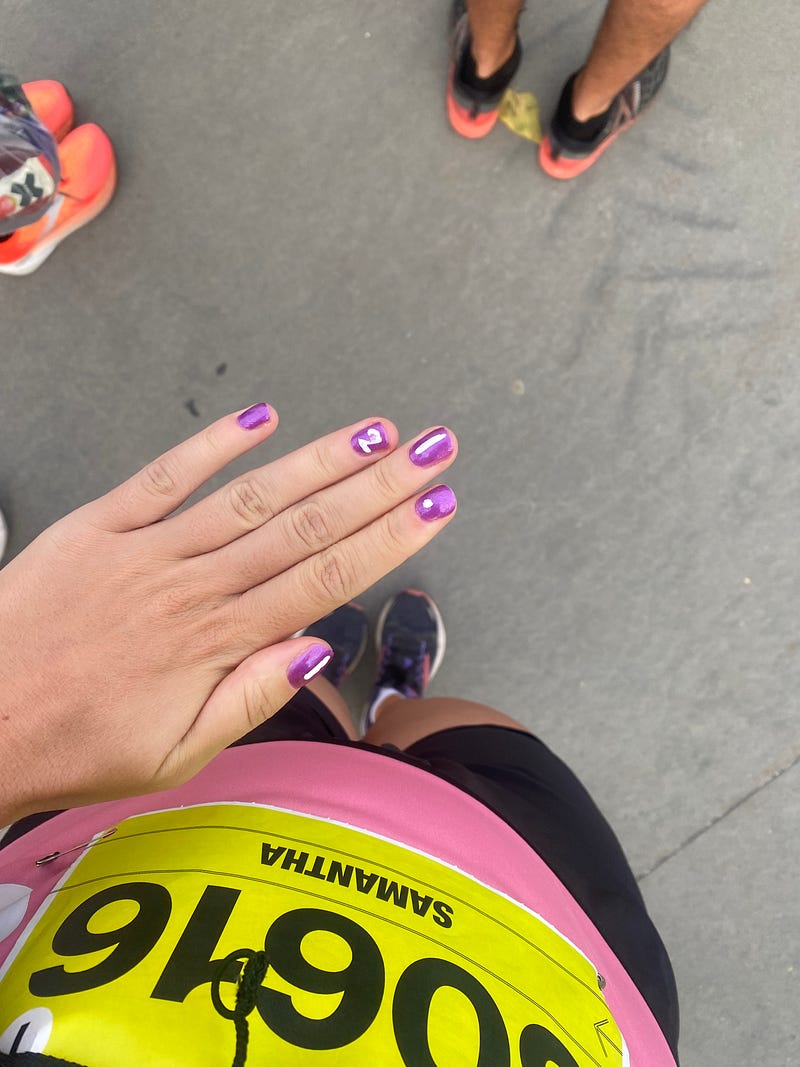
But a few things led me to start changing my mindset. I ran a couple of good and short shakeout runs in the week leading up to the race and I felt strong. I became superstitious. The half marathon had gone great, and I tried to recreate everything I had done leading up to it, down to the brand of cereal I ate before, the cross necklace I wore, and how I did my nails, which I ended up painting with the numbers 21.1 last time, and 42.2 this time. I made a plan. The night before the race I wrote down my pacing strategy in my diary. A marathon was 7 times 6 km.
I also read an article called Running and the Science of Mental Toughness which popped up in my inbox from one of the many running magazine’s I’d signed up to. It asked the question: “What goes on in the minds of people who voluntarily expose themselves on a regular basis to the rigors and stress of long-distance running?” and described research where runners were asked to narrate their thoughts into a microphone during long-distance runs. In neurology, the central governor theory proposes that your brain rather than your body controls the point at which you give up on a physical effort. This explained why you could feel close to your limit on a run, but the moment you saw the finish line, you had energy to speed up. Our brains are trying to protect us from overexerting ourselves physically. What this said about runners whose goals were to push past these limits, I wasn’t sure, but I took a mental note that even if my brain wanted me to stop, my body might still be able to keep going. I started to see my number games as perhaps more than a wandering mind looking for something to think about. Maybe this strategy had value in building the “mental toughness” needed to run long distances.
Then, I deleted or ignored my social media apps, where last minute advice was bound to crop up. Even if my friends’ intentions were good, they wouldn’t be able to help me once the race started. I was the one who had to run it, and only I really knew exactly what I was capable of, and what worked best for me. In real life, I ran into one friend, an avid marathoner, who said, when I expressed my doubts about finishing, “you can do it, I’ve seen all your runs on Strava.” At the starting line, my dad gave me a fist bump and said: “We’re gonna do it.” I realized that all this time I was focusing on advice that made me doubt myself, because it mirrored the doubts I felt. I had tuned out all the encouragement.
Finally, the last thing I did before the race that helped me was give up. The fact that I had been so close to selling my spot or transferring to next year, meant that whatever I did now, would be a success, would be better than not trying at all. In the worst case scenario, I would get a ride in the bus, and try again next year. Maybe that advice I’d received so many months ago, about running another marathon just for practice, wasn’t so bad after all.
Finally the day of the race came, and there was no more time to worry about how it would go. The air was cold in Val-David that morning. The runners huddled in old blankets and sweaters that they would later discard along the course, like Philippides shedding his armor. I felt a sense of calm as we approached the starting line. As we set out, I stuck to my plan, and ran the first half of the race faster than I even expected thanks to the sloping course and the atmosphere of the race. Yellow and red leaves drifted across the trail, and at times views opened up through the trees showing the surrounding hills ablaze with fall colours.
At around 25 km in, I noticed the chain of my necklace had broken, and I lost the cross — so much for superstition. But at that point I was close to my mental “endpoint” of 30km, where I knew there were only 2 sets of 6 kms left. My dad had passed me a ways back, but I didn’t mind, because I knew I was running my own race. After 35 km, the words I don’t want to run anymore kept ringing in my ears, but I knew not to listen to them. The most important thing was to keep moving forward, and by now, I knew I could do it. In the last 3 km, the crowds cheering from the sidelines urged me toward the finish.
When I crossed the line and got my medal, one of the first things I did was sit down in the grass. I wish someone had warned me not to do that, as I felt the lactic acid painfully building in my legs almost immediately. I found my dad and we hugged. I felt like I had proven something to myself — something my dad had taught me: that if I believed in my own abilities, I could do hard things.
I also realized that marathon running is not a team sport. It’s a personal journey, and no amount of well-meaning advice can replace the sense of your own capabilities that comes from experience. That being said, if someone were to ask me for my advice about running your first marathon, I would say this: count to 7, paint your nails, don’t listen to me, listen to yourself — except when you’re telling yourself to stop.
 selective
Leave a comment