
Why does one write a diary?
Is it simply to create a record for posterity, or is there something more to it?
Traditionally, the daily account of someone’s life serves as a window into history. We read historical diaries to get insight into how people lived in the past. “See, they were just like us!” It seems only natural to picture an English government worker of the restoration period or a wartime wife in the 1940s writing a diary. But in 2024, is anyone recording their day-to-day life in written form in any detail?
I have to assume that people in the past were much more bored than we are today. Why spend time writing down your thoughts in a journal, when you can make a 280-character post on X or record yourself in a seven second TikTok video? But, perhaps counter-intuitively, the idea of journaling is huge in online spaces. Whether as a form of “mindfulness”, a mental health coping strategy, or a creative outlet, journaling is all over my ForYou page. Even Matthew McConaughey touted the powers of journaling in a viral clip. “You don’t have to write anything good. It doesn’t have to be good at all. You don’t even have to write, you can doodle, you can draw, you can scribble… there are no rules with journaling!”
An all-too important part of the modern diary is making sure other people know that you have one. On Pinterest, for example, one can scroll through a seemingly endless stream of stationery, “bullet journaling” page layouts, gratitude prompts, and so on. Writing down one’s deepest thoughts, supposedly “just for me”, can become ironically performative, especially in online spaces. Susan Sontag formulated the same thought in her own eventually published journals: “One of the main (social) functions of a journal or diary is precisely to be read furtively by other people, the people (like parents + lovers) about whom one has been cruelly honest only in the journal. Will H ever read this?” Deep down, we all secretly hope someone will read our diary. Otherwise, what would be the point of writing it?
TikTok user dumbmackenzie takes this literally, reading embarrassing but hilariously honest diary entries from her pre-teen years to an audience of over 400 thousand followers. Her second most watched video (16 million views) is an entry in which she confesses to having eaten the lip gloss her mother bought her, gleefully recorded in pink gel pen (“BEAUTY TASTES GOOD”). The popularity of this type of content seems to suggest that the diary is alive and well in modern times, perhaps predictably, considering the fascination of making the personal public on social media, whether genuine or filtered.
Another online niche is researching long-forgotten diaries and reciting them for a TikTok audience. Resurfaced recordings of gentleman callers, letters received and sent, plays attended, and mornings of breakfast in bed at friend’s estates, are the fare of a 1917 diary by a woman named Anglesea, shared by the TikTok account thingslostandfound. In one viral video, a tiny booklet is found hidden in the 1917 diary, listing the names of the men the writer went on dates with, complete with a symbol system next to each name. “She walked so me and my notes app could run” says one comment on the video. Addi, the woman behind thingslostandfound, playfully hints that some of the names can be matched to people mentioned in the diary, and wonders what the hand symbol drawn next to the name of one Carley Waller could mean. People love to peak into the daily minutiae of strangers. What seems to strike us is the relatability, even across over 100 years, of thoughts, feelings, and even methods of cataloguing potential suitors. And the allure of watching Addi recite one entry after another, piecing together the story of a woman’s life at the turn of the last century, is partly that this is a true story, potentially more real and messy than the perfect novel.
But how real are they? Watching Anglesea’s love affairs re-counted on TikTok, I inevitably imagine that in 100 years, someone would be as fascinated by my own life, if only I record it properly now. But in imagining something like that, how much does one subconsciously edit their own writing, their own thoughts even, to include only the interesting things, to embellish here, to change slightly what was said there, to alter the way they perceive even themselves.
I recently read Sheila Heti’s Alphabetical Diaries. I had planned to attend Heti’s book launch at the Librairie Drawn & Quarterly in Montreal, but was unable to make it. At the local book store, they had a few signed copies of the book. The cashier said she had gotten them signed at Heti’s book launch. When I asked her how it had gone, she seemed unsure, and I could tell there was something about the talk that had made her uncomfortable. She mentioned Heti had focused on the concept of editing.
The premise of the book is that the author took 10 years of her personal diaries and rearranged all the sentences so they would be in alphabetical order. Cutting it down, the result was around 200 pages, split into 26 chapters, one for each letter of the alphabet. So for example, Chapter 1 starts with the sentence: “A book about how difficult it is to change, why we don’t want to, and what is going on in our brain.” Followed by “A book can be about more than one thing”, and so on.
As I carried this book around reading it for about a month, I got mixed reactions when people asked me what it was about. One of my friends said: “Sounds like she was late for her book deadline.” My mom said it was “excellent” and loved the premise, probably because as a cataloguing librarian she is enthusiastic about alphabetizing things.
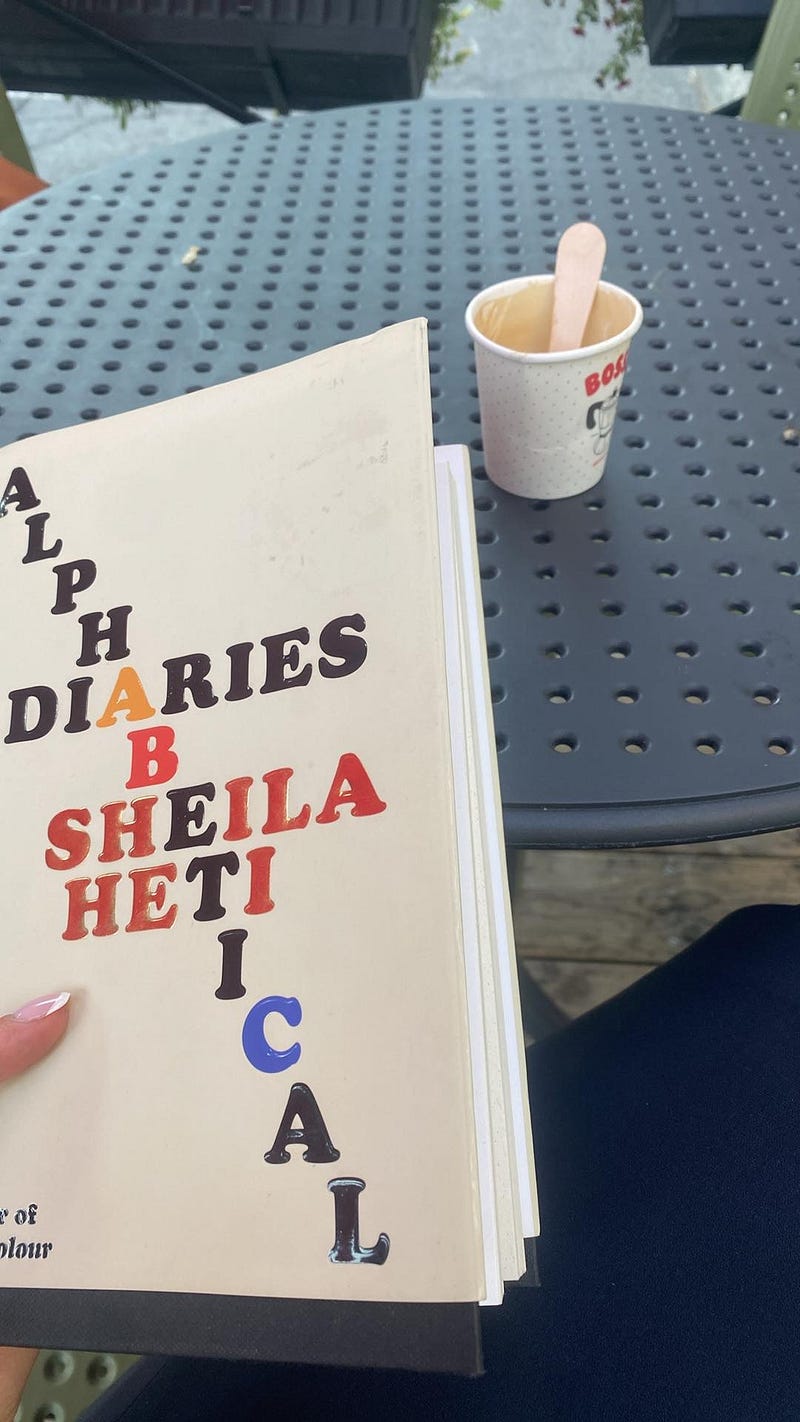
The book delivers on the diaristic promise of providing elicit insight into another person’s innermost thoughts. The sentences do an excellent job of expressing a complex idea in a single sentence, weaving together coherent themes about art, relationships, finding oneself, and a recurring metaphor about apples. I told a friend I liked it because it was “high on themes, low on narrative.” And although the sentences were seemingly disconnected, hints of a story peaked through via relationships with various people in Heti’s life, friends, fellow artists, and lovers, so that I found myself thinking, “I can’t wait to get to chapter P or L or V” to see what she had to say about certain people repetitively mentioned.
However, the stories that did come through — a stagnating relationship potentially marred by an affair, the inception of a new career path and the doubts about following that path — were sometimes difficult to piece together and got lost in the artistry and the somewhat repetitive themes and anxieties of the narrator. And although a narrative revealed itself with difficulty, the experimental nature of the book’s format revealed a tension in the traditional concept of a diary being a factual account.
“She was the sort of person who saw lonely, solitary sadness, when all around her there was love just pouring forth, just gushing forth from every direction. She was the sort of person who saw only one apple in a tree that was just littered with apples.”
What I think bothered the girl in the book shop was something Heti had said at her book launch about editing versus writing. If the premise of a book is that it consists of the contents of one’s diary, there should not be much editing required. Based on the premise alone, the sentences were simply entered into a word processor and re-ordered. But after reading the book, it seems obvious to me that painstaking editing was required to ensure each sentence really was the alphabetical subsequent of the previous one, while maintaining the flow and impact of reading them together, as if they were meant to follow one another, chosen deliberately and with precision. Although this may seem somewhat dishonest, it reveals a key element of any diary, published or otherwise: the unreliable narrators that we all are when it comes to our own stories.
 selective
Leave a comment